SS United States shows how an ocean liner could be shaped by speed, lightweight construction and risk management, not luxury alone. In 1952, on its maiden service crossing, the American ship set an Atlantic record. Its red, white and blue funnels became a symbol of mid-century industrial ambition.
This tenth chapter of Legends of the Ocean looks at how William Francis Gibbs and his team combined powerful steam machinery, a slender hull and extensive use of aluminium in the superstructure. Its passenger spaces and later life also complicate a simple story: the fastest ship did not keep its market forever.
The 1952 Blue Riband: performance came from the whole system
Newport News Shipbuilding built SS United States for United States Lines, with a contingency requirement that it could be converted to a troopship if needed. This was a project with both commercial and strategic purposes, not simply a contest to design a glamorous cruise ship. Its capacity and speed must be understood in the context of the early Cold War.
On its westbound Atlantic crossing in July 1952, the ship covered the measured passage in 3 days, 10 hours and 40 minutes, averaging about 35.59 knots. That figure is not the time from passengers boarding to leaving the terminal at the other end. A maritime record has defined start and finish points and should not be confused with the total duration of a trip.
One knot is one nautical mile per hour, or 1.852 kilometres per hour. Converting the unit helps convey the speed, but the number alone does not explain the achievement. A large hull had to maintain speed over thousands of nautical miles, requiring machinery, water flow around the hull, fuel reserves and watchkeeping to work together rather than producing a brief burst of acceleration.
The ship used four propellers: according to the SS United States Conservancy, two had four blades and two had five, with notable design work by engineer Elaine Kaplan. The photograph above records a preserved propeller displayed ashore, not a propeller still fitted to the ship. An isolated component reveals blade geometry usually hidden below the water in photographs of a vessel underway.
The ship’s performance also depended on its long, relatively slender hull. The lesson is not “install a larger engine and get a record”; it is to reduce the resistance that wastes power. Hull, machinery and material choices had to support one another. A change in one area could make weight or stability more difficult elsewhere.
Aluminium, lightweight structures and material choices
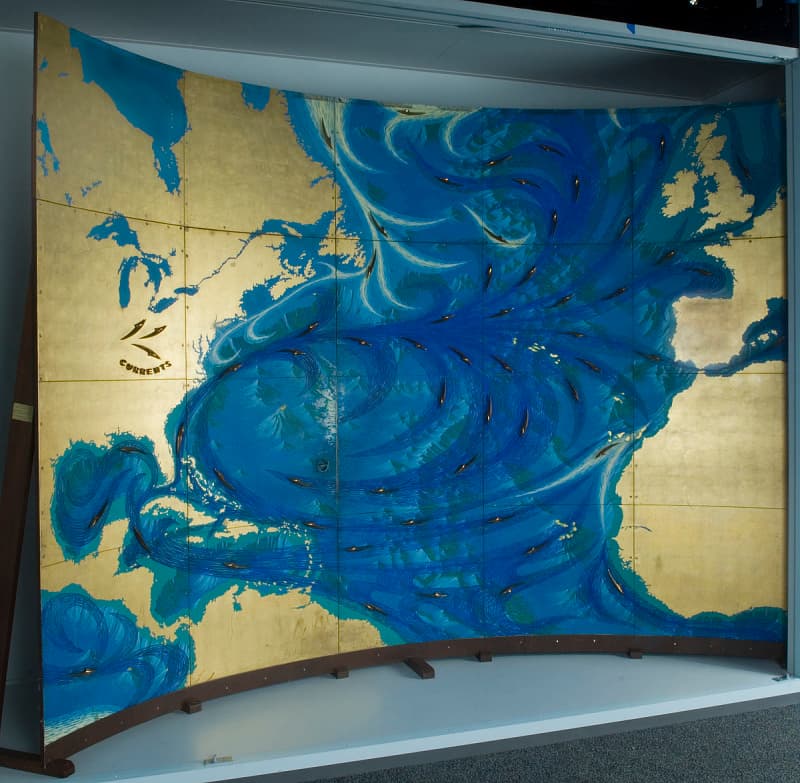
The Currents, an aluminium artwork from SS United States
Image: Raymond John Wendell, photographed by the Smithsonian, via Wikimedia Commons, CC BY-SA 4.0.
A notable feature of United States was its extensive use of aluminium in the superstructure rather than building all of the upper works from steel. The main hull remained steel; calling it an “aluminium-hulled ship” would be misleading. Distinguishing hull from superstructure clarifies where weight savings were sought.
Reducing weight high above the waterline can help control a vessel’s centre of gravity and provide more design flexibility. But aluminium is not a magic material: performance at temperature, galvanic corrosion where unlike metals meet and the choice of joints all need attention. Good engineering means using the material in the right place, not claiming it is always superior.
The aluminium artwork The Currents by Raymond John Wendell in the photograph decorated a public space aboard the ship and is documented in a Smithsonian collection. It is not a cutaway of the superstructure or direct evidence of hull construction. Its value is that it shows how the material philosophy extended into passenger-facing objects as well as engineering.
The design team also sought to limit combustible materials in the interiors. Aluminium and alternatives to wood were considered for both weight and fire safety, creating a different approach from earlier liners with extensive woodwork. Yet “reduced combustible materials” does not mean “fireproof,” and it does not eliminate the need for detection, compartmentation and emergency response.
The link between materials, weight and safety makes United States worth studying. A lighter decorative component may look like an aesthetic choice, but multiplied across a ship it becomes part of the engineering problem. A liner is a place where many small decisions can add up to performance—or cost—depending on how consistently they are made.
Safety and passenger experience were connected
SS United States first-class dining room, 1953
Image: United States Library of Congress and Gottscho-Schleisner, Inc., via Wikimedia Commons, public domain.
The 1953 first-class dining-room photograph shows that United States was still designed to serve premium passengers. It was not an empty military machine whose only function was speed; its technical ambitions coexisted with restaurants, public rooms and places to live. Passengers experienced design through meals, sleep and convenience, not just average speed.
The Conservancy documents a lifeboat and raft capacity designed with substantial provision for people aboard. Safety figures should not be turned into an absolute guarantee. Evacuation also depends on procedures, trained crew, functioning equipment and conditions that permit it; multiple safeguards have to work together.
Likewise, a dining-room image cannot prove every detail of the ship’s fire protection. A photograph records layout and appearance at one moment; it cannot replace a materials schedule or technical record. Images and design documents answer different questions and should be read together.
High speed does not automatically make every voyage better. Comfort also depends on sea state, vibration, noise and how passengers spend their time. For liner enthusiasts, the appeal lies in balance: a powerful vessel built to cross quickly, yet still a place where people must eat, sleep and live for days.
By the 1960s, jet aircraft increasingly attracted transatlantic travellers. United States left service in 1969, even though its speed achievement remained remarkable. This is an important economic lesson: excellence in a technical contest does not keep a vehicle relevant when customers change how they choose to travel.
The legacy of SS United States goes beyond a record
SS United States in Philadelphia before its 2025 tow
After leaving passenger service, United States changed hands several times and plans for reuse repeatedly failed to materialize. Parts of the interior were sold or removed over the years, so the ship’s later appearance was far removed from its 1953 interiors. Photographs of the vessel laid up need to be dated; they do not show its appearance in active service.
The February 2025 morning photograph records the stern in Philadelphia as the ship prepared to be towed away. It documents an event that took place; it does not confirm the ship’s current location or guarantee what will happen to it in the future. Preservation and reuse plans can change. This article focuses on the ship’s technical history, not on promoting a visitor attraction as currently open.
What matters most is how several aims shaped one design: speed while carrying passengers, reduced weight without abandoning structural requirements, and fewer combustible materials without giving up comfort. SS United States deserves its place as a milestone because of that combination, not simply because it once led a record table. The record catches our attention; the choices behind it keep us learning.
47.Art offers an SS United States variant in its v4.0 ship-model range. Although the product page title also mentions Normandie, Britannic and Titanic, the catalog has a distinct SS United States option; select that variant when viewing the model. A 3D-printed collectible can bring the story into a display case, but it is not a certificate of the real ship’s power or technical specifications.