SS Normandie was at once a hydrodynamic experiment, an electric-transmission engineering project and an Art Deco statement. Entering service in 1935, the French liner brought fluid lines to the Atlantic, but its beauty was inseparable from its technology. Beneath its grand public rooms, steam turbines generated electricity that powered the propeller motors.
This eighth chapter of Legends of the Ocean looks beyond Normandie as a lost floating palace. Hull design, power transmission and interior architecture were parts of a single project. The story also has a limit and a tragic ending: advanced technology could not make the ship immune to the risks of wartime conversion.
Between the world wars, transatlantic passenger travel was no longer driven only by migration. Changes to immigration policy and travel demand led shipping companies to focus more on passengers paying for comfort, space and the journey itself. A large liner could sell tickets and represent national prestige, increasing pressure to distinguish it from competitors.
The French Line, or Compagnie Générale Transatlantique, built Normandie at Saint-Nazaire in response. The ship was launched in 1932 and entered service in 1935. That interval was a period of outfitting and completion; a ship was not ready for passengers merely because its hull had first entered the water.
Normandie was about 314 metres long and made a record Atlantic crossing on its maiden voyage in 1935. Its speed contest with Queen Mary became one of the best-known rivalries of the era. The Blue Riband referred to particular passages and directions; it was not a universal claim that a ship beat every competitor at every measure.
The aerial photograph above shows Normandie at Pier 88 in New York in 1941, not during a record run. From above, its length, decks and relationship to the port become easier to see. A large liner depended on matching infrastructure: berths, channels, fuel services and systems for handling passengers and luggage.
This context makes Normandie more than a story of luxury. It was a financial, engineering and branding gamble during a difficult economic period. Becoming an icon did not make construction costs or profitability easy problems; national prestige and commercial returns do not always rise together.
Yourkevitch’s hull and the turbo-electric principle
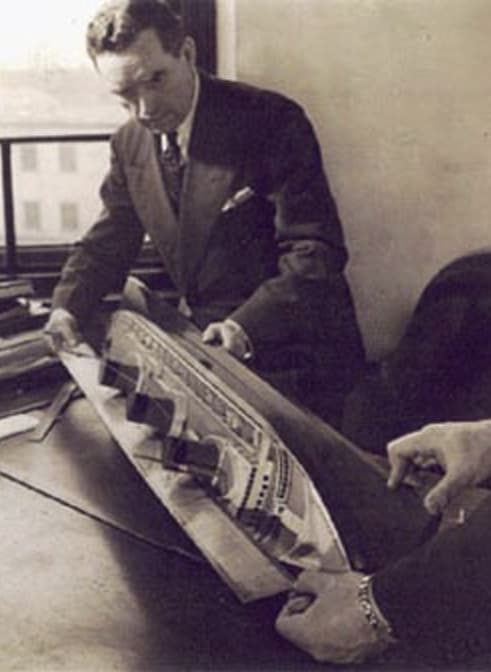
Vladimir Yourkevitch with the Normandie model
Image: photographer unknown, made before 1932, via Wikimedia Commons, public domain.
Vladimir Yourkevitch played an important role in Normandie’s hull form. His model studies explored reducing resistance through the waterline and bow geometry, including a bulbous forefoot below the water. This was not only a stylistic choice: the energy needed to move a hull through water depends significantly on its shape and operating conditions.
The photograph of Yourkevitch with a model is authentic design-process documentation, not a 47.Art commercial model. It does not show the turbo-electric plant itself. It illustrates how the vessel was studied at model scale before its lines became thousands of tonnes of structure.
In a turbo-electric drive, steam turbines turn generators; electrical power is then delivered to motors connected to the propeller shafts. On Normandie, this replaced a direct mechanical path from turbines to propellers through reduction gearing. The energy source was still steam produced by burning fuel; calling the ship an emission-free electric vessel would be inaccurate.
Separating power generation from propulsion offered options for machinery arrangement and control. Generators, motors, cables and controls also added mass, losses and maintenance needs. No transmission system has advantages only; the value of a design comes from matching its trade-offs to the ship’s mission and scale.
Normandie was a milestone in integration, not the first invention of every technology it carried. A low-resistance hull and powerful machinery worked together; engine output alone cannot explain its performance. The ship also links to later electric-drive vessels, even though power sources and propeller arrangements differ from ship to ship.
Art Deco: the interior was more than decoration
SS Normandie’s grand dining room, circa 1935
Image: photographer unknown, made in France circa 1935, via Wikimedia Commons, public domain.
The grand dining room in this circa-1935 image shows a style of luxury built around strong geometry, generous proportions and carefully organized light. Rather than simply copying a palace ashore, Art Deco helped convey modernity, confidence and distinction. The interior became part of the French Line’s story about France.
Shipboard design operated under more constraints than a publicity photograph suggests. Public spaces had to fit within the hull and work alongside passages, ventilation, galley service and technical routes. Rooms that passengers experienced as a single grand space were the result of coordination between architecture, structure, equipment and hotel operations.
Separating engineering “below” from art “above” is a useful shorthand, but only a shorthand. Machinery, ventilation and compartment layouts affect how much space can be offered to passengers. An ambitious interior also makes engineers solve harder problems of area, weight and movement through the vessel.
The dining-room image documents a historical interior; it does not show that every passenger class had the same experience. Liners of the era divided spaces and services by class. A magnificent room should be viewed alongside the engine spaces, crew accommodation and service areas rarely seen on postcards.
Normandie appeals to model collectors for both its outline and its design story. When studying a miniature, look at the bow proportions, deck lines and funnel placement before counting decorative details. A model can prompt an understanding of design, but it is not a substitute for technical records or shipyard plans.
The 1942 fire and Normandie’s remaining legacy
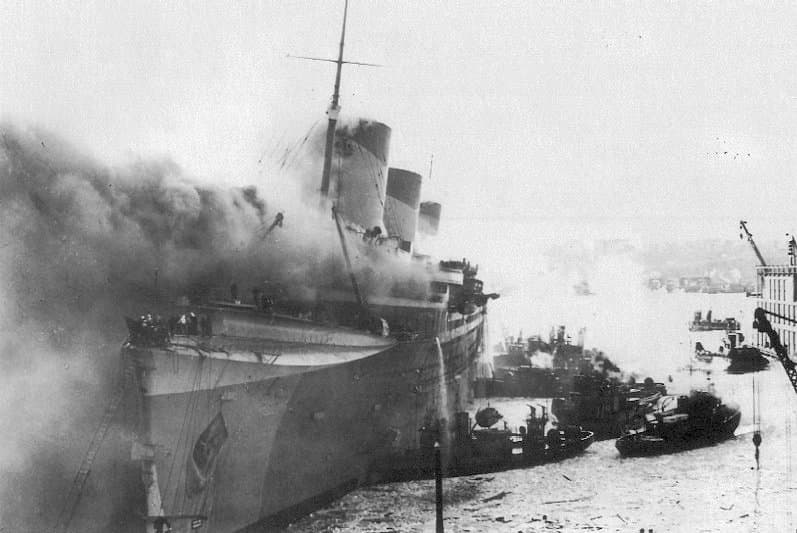
Fire aboard Normandie in New York, 1942
Image: U.S. National Archives photograph, via Wikimedia Commons, public domain.
When war broke out in Europe, Normandie remained in New York, was taken over by U.S. authorities and renamed Lafayette. On 9 February 1942, during conversion for troop transport, the ship caught fire at its pier. During firefighting and the flooding that followed, it listed and capsized to port; it never returned to passenger service.
The smoke photograph is U.S. archival documentation of an actual fire at the pier. It should not be used to describe a sinking at sea, nor should sabotage be asserted without evidence. After costly salvage work, restoration was judged uneconomic and Normandie was scrapped after the war.
The disaster shows that safety is not just an attribute of a ship at delivery. During conversion, the organization of work, combustible materials, systems taken out of service and emergency response can all change the risk. A liner that set records at sea could still suffer a catastrophic accident in port; engineering achievement never makes operational practice secondary.
Normandie survives in photographs, artifacts, plans and miniatures. The 47.Art catalog offers an SS Normandie variant in its v4.0 ship-model range: select the SS Normandie option rather than Titanic or Britannic. This is a 3D-printed collectible suggestion, not a claim that every detail or scale matches a museum-grade model.