RMS Mauretania turned steam turbines from a promising technology into the heart of an ocean liner able to hold a speed record for years. Launched in 1906 and entering service in 1907, the Cunard ship made an impression with more than its four funnels. It showed how propulsion, hull form and operating practice could combine into a lasting advantage on the Atlantic.
This fifth chapter of Legends of the Ocean concerns the original Mauretania, not the later Cunard ship of the same name introduced in the late 1930s. Its story runs from the River Tyne shipyards to the Blue Riband and then to wartime hospital-ship service. Behind the record were engineering decisions, demanding work in the machinery spaces and limits that speed alone could not solve.
Mauretania enters Europe’s ocean-liner race

Image: Unknown photographer, via Wikimedia Commons, public domain.
At the start of the twentieth century, the Atlantic route was a major transport market and a showcase for industrial capability. Shipping companies competed over arrival times, amenities and prestige; large, fast German liners put pressure on British operators. A successful ocean liner therefore had to be more than attractive: it needed a credible operating plan that could win passengers and contracts.
Cunard developed Lusitania and Mauretania in this setting, with British government support tied to service obligations if required. Swan Hunter and Wigham Richardson built Mauretania at Wallsend on the River Tyne. On 20 September 1906, its launch sent the enormous hull into the water, but machinery installation and completion work still remained before it could carry passengers.
The launch photograph documents a stage of production, not simply a finished ship portrait. An ocean liner was the product of hull fabrication, mechanical engineering, boilers, electrical work, interiors and a network of suppliers. The ship’s name might dominate newspaper coverage, but the capability to build it rested on the industrial system behind it.
A significant design choice was the adoption of steam turbines rather than simply scaling up reciprocating steam engines. Turbine propulsion had already been demonstrated and tested at sea; Mauretania did not invent the principle. The milestone was putting turbines to work in a large passenger liner operating regularly on a competitive route.
Three dates help keep the chronology clear: launch in 1906, entry into service in 1907 and the westbound record in 1909. Compressing them into a story in which the ship appeared and immediately won every record would erase the trials, adjustments and accumulated experience between those events. Engineering history is more instructive when the process remains visible.
How steam turbines and four propellers worked together
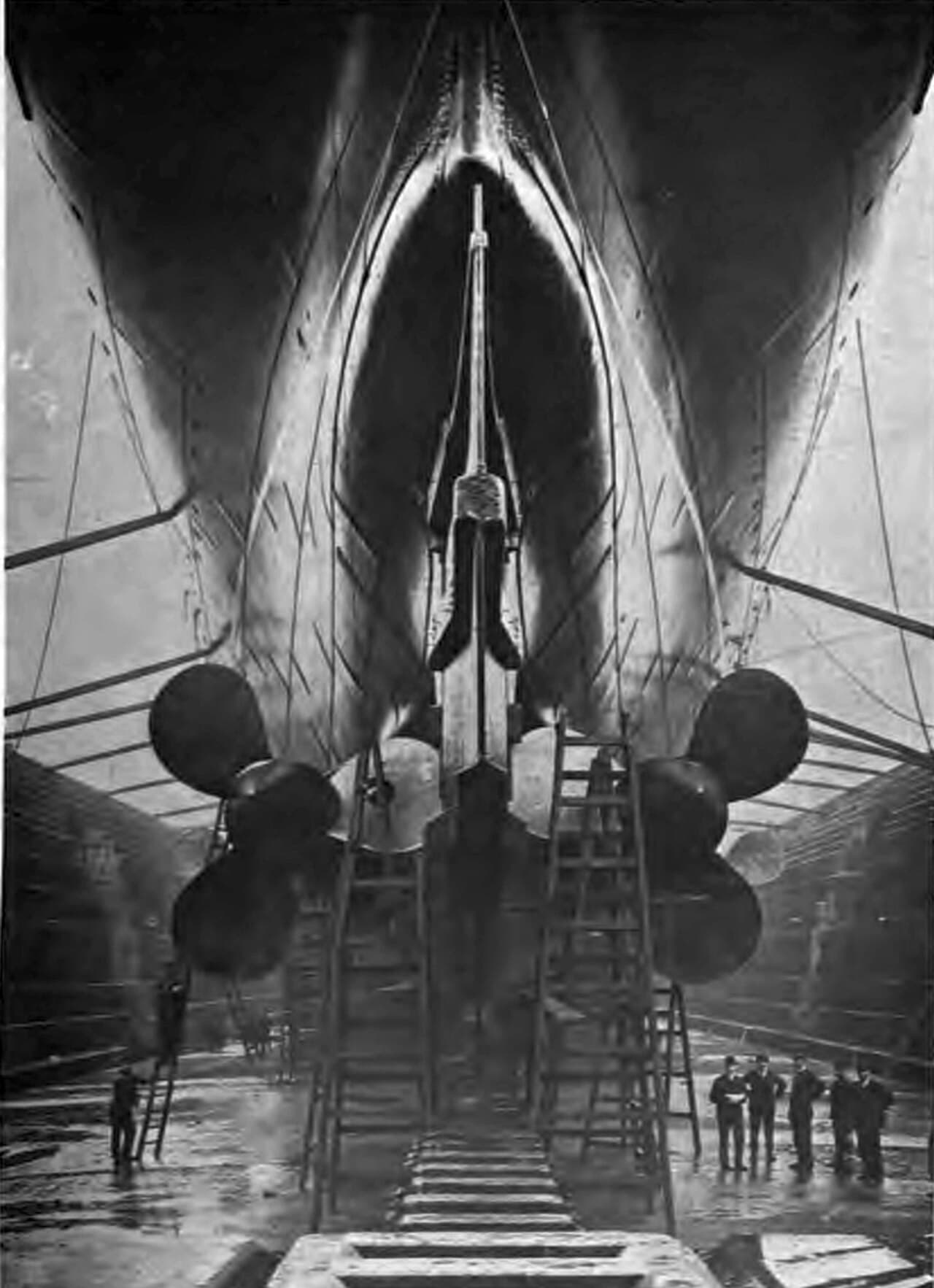
Image: Doubleday, Page & Company, publisher, via Wikimedia Commons, public domain.
A reciprocating steam engine produces back-and-forth motion that is converted into rotation. A turbine uses steam flowing through rows of blades to turn a rotor continuously. For a ship requiring substantial power over a long passage, that difference offered a new way to arrange propulsion, while also requiring careful matching between the turbine’s speed and the propellers.
Mauretania used Parsons turbines to drive four propeller shafts. Boilers produced steam, the turbines converted its energy into mechanical rotation, and the propellers transferred thrust to the water. The components had to be designed as a system: adding power without accounting for the flow around the stern or the load on the propellers could create vibration and waste rather than useful speed.
The dry-dock photograph shows people dwarfed by the ship’s propellers, but it is not a diagram of the turbines. It makes clear why shore-side engineering, time in dry dock and the ability to manufacture huge components mattered to a ship’s reputation at sea.
The machinery and propeller arrangement did not remain fixed throughout the liner’s whole career. Trials, alterations and refits allowed operators to respond to experience. One early photograph should not be taken as proof that every later voyage used exactly the same blades and configuration.
Behind the funnels was machinery that demanded continuous attention. When the ship burned coal, feeding fuel to the furnaces and maintaining steam pressure were arduous tasks, rarely featured in promotional pictures. Turbines did not eliminate maintenance, nor did they make a steamship fuel-free.
Why Mauretania’s Blue Riband record mattered
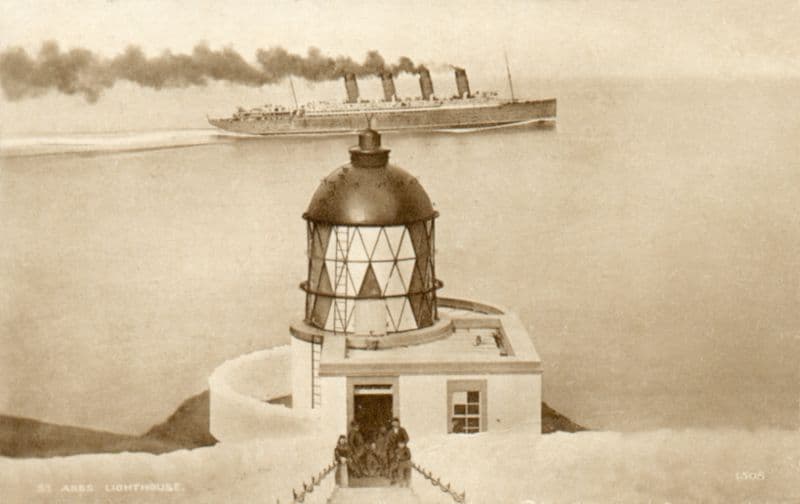
Image: P. Nisbet, via Wikimedia Commons, public domain.
The Blue Riband is associated with Atlantic-crossing performance, commonly compared by average speed over a defined passage. It is not a brief peak-speed reading during a trial. Route distance, direction, currents and weather all affect how a record should be understood; the headline number alone does not tell the whole story.
Mauretania set the eastbound record on its first return crossing in late 1907, then claimed the westbound record in 1909. Its westbound mark stood until 1929, when Bremen opened a new chapter in the contest. Saying it held the Blue Riband for about two decades is useful shorthand, but the records were tracked separately by direction.
The sea-trial photograph captures the central challenge: a large hull must move through water, not merely house powerful engines. Its archival caption describes a trial near St Abbs Head; it should not be presented as an image of the 1909 record crossing. Separating these events lets the image illustrate engineering without inventing a connection the source does not establish.
A long-lived record also reflects the ability to operate and maintain a design. The ship endured many seasons, refits and changes in the market. One fast run creates headlines; years of reliable service establish a benchmark competitors must work to surpass. Mauretania’s reputation came from both.
Speed is not the only measure of a great ocean liner. Other ships made important contributions to safety, efficiency or passenger experience without being the fastest. Mauretania belongs in this series not to turn maritime history into a leaderboard, but to show how turbines were tested at commercial scale.
Hospital-ship service and the legacy after speed
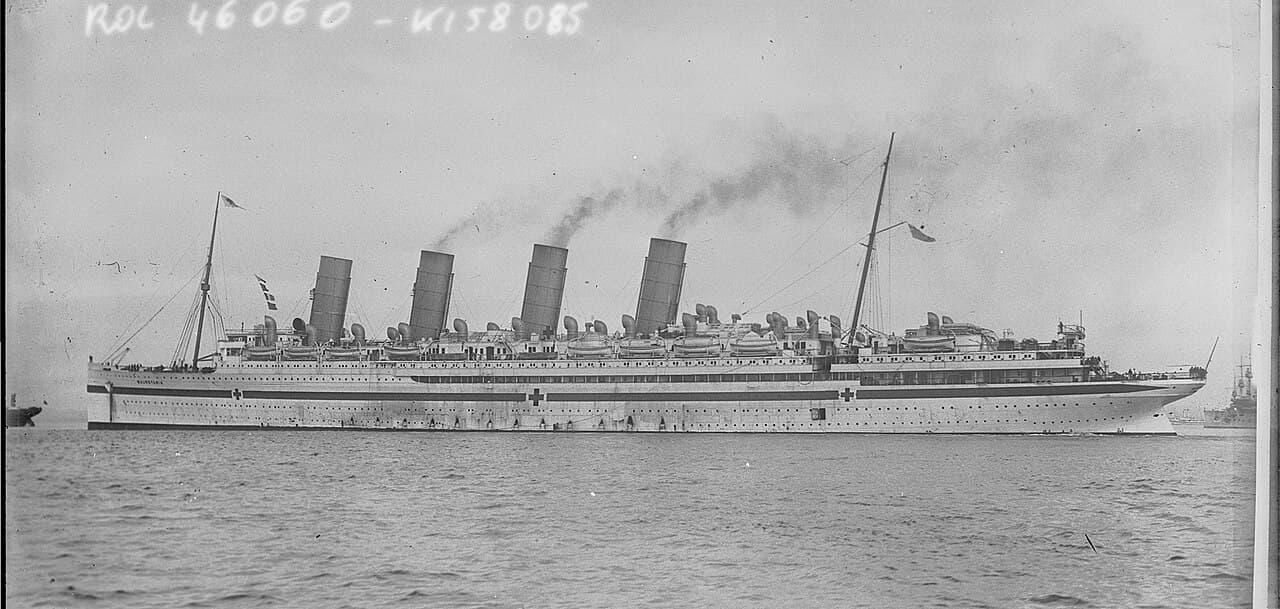
Image: Ernest Brooks, via Wikimedia Commons, public domain.
The First World War changed the work of many passenger ships. Mauretania served as both a troopship and a hospital ship, far removed from its peacetime image. Ernest Brooks’s 1915 photograph at Moudros shows medical markings and a different role for the same ocean-going hull.
Its wartime hospital service should not be confused with a ship originally designed as a specialist medical vessel. Mauretania was an ocean liner requisitioned and adapted for a new task. Its passenger capacity, range and speed had value during wartime, but spaces and procedures had to be reorganized around the mission.
After the war it returned to civilian service and underwent further changes, including conversion of its boilers to burn oil. The ship was withdrawn in 1934 and scrapped in 1935. Keep the generations distinct: photographs of a Mauretania taken in the late 1940s show the later vessel, not the four-funnel liner discussed here.
Mauretania shows that an engineering milestone must be measured by both performance and sustained service. If you enjoy classic multi-funnel silhouettes, 47.Art has a Titanic model for your collection. The catalog does not currently list a Mauretania model; Titanic is a different ship from another period, not a substitute bearing the same name.
Sources and further reading
- Dates, turbines and direction-specific records: RMS Mauretania (1906).
- Trial, propeller and hospital-ship photographs are individually credited above; these archival images are not 47.Art product photography.
- Continue with Normandie and turbo-electric propulsion.